
Another day, another new subscriber to my email list!
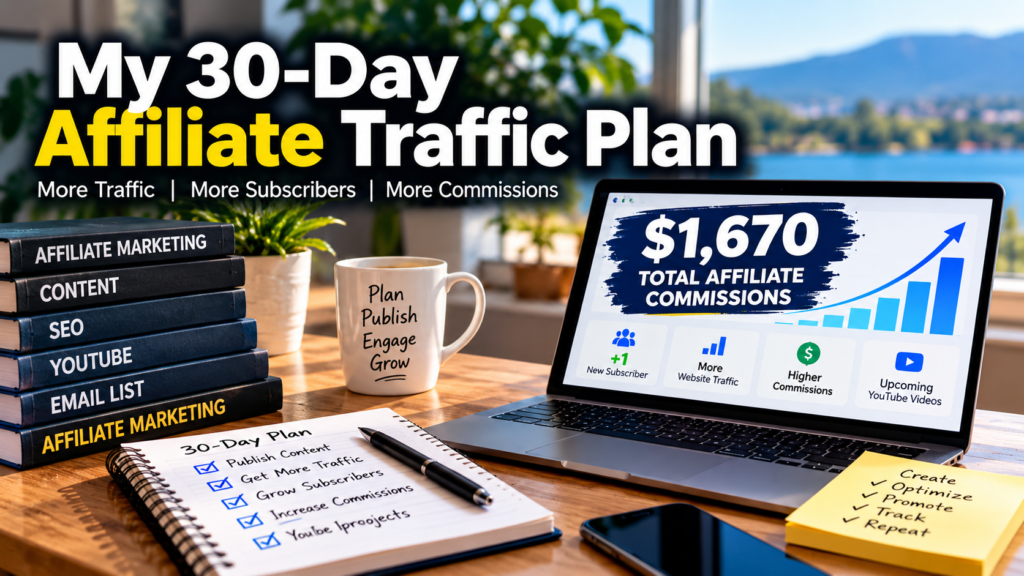
My total recorded affiliate commissions currently stand at approximately $1,670, and although today hasn’t brought any particularly dramatic developments, I’m beginning to think more seriously about how to improve the traffic coming to my online business.
Not simply by publishing more content.
But by making better use of the content I’ve already created.
That’s why I’ve been looking at ways to develop a more focused affiliate marketing traffic plan, based on the things I’m learning, the results I’ve achieved so far and some useful ideas from John Thornhill’s latest ClickBank Profit Club training.
I’ve also managed to fit in a short workout today.
Later, I’ll be spending a few hours at my regular job.
And while I won’t have time to work on my next YouTube video this week, I’m planning to get started on it next week.
So there’s plenty going on!
But today, I want to focus on something particularly important for anyone trying to build an online business.
How do you attract more visitors without constantly having to create something new?
My Affiliate Marketing Progress: Approximately $1,670 Earned
Let’s begin with a quick earnings update.
My recorded affiliate commissions currently total approximately $1,670.
As I’ve explained in previous articles, these earnings have come through opportunities I’ve accessed thanks to ClickBank Profit Club, a program created by John Thornhill.
I’m pleased with the progress, although there’s still a considerable distance between my current results and the kind of consistent online income I’d eventually like to achieve.
And it’s important to remember that total commissions are not the same as net profit. I’ve also invested money in training, mentoring and tools.
Nevertheless, earning real commissions has helped me understand how affiliate marketing works in practice.
I’ve learned about digital products, email marketing, affiliate funnels, automated follow-up sequences and the importance of attracting genuinely interested visitors.
And here’s something I think deserves more attention:
ClickBank Profit Club is free to join at the basic membership level.
You can explore the program, see how it works and decide whether it’s something you want to pursue.
There are optional paid upgrades offering higher commission opportunities and additional benefits, but those upgrades are entirely voluntary.
If you’re interested in discovering the system I’ve been using, you can start here:
Join ClickBank Profit Club FREE – Explore the System for Yourself
There’s no guarantee of earning money, of course. My results are personal to me, and your experience could be very different.
But I appreciate being able to share what I’ve actually learned rather than simply repeating theoretical advice.
Another New Subscriber – Why Every Genuine Lead Matters
I’ve also welcomed another subscriber since my previous update.
One new subscriber might not sound particularly impressive.
But I believe it’s important to appreciate these smaller developments.
Building an email list is about more than collecting addresses.
It’s about establishing a way to communicate with people who have expressed an interest in your content.
Someone might discover your blog through a Google search.
Another person might see a post on LinkedIn.
Someone else might find you through Substack.
If they find your information helpful, they may decide to subscribe and continue following your journey.
That’s the kind of relationship I want to develop.
I already use AWeber to manage my email marketing, and I’ve spent time improving the sequences that subscribers receive.
But there’s an important lesson here.
An automated email sequence isn’t particularly useful if nobody discovers your website or signs up.
That’s why traffic generation deserves so much attention.
And that’s exactly what I’ve been thinking about today.
A Smarter Affiliate Marketing Traffic Plan
I’ve recently been reviewing some of John Thornhill’s ClickBank Profit Club training materials.
One of the workbooks, The CBPC Traffic Accelerator, emphasizes three important activities:
Publishing. Participating. Promoting.
It’s a simple framework.
Publishing means creating content that helps people discover you.
Participating means joining relevant conversations and contributing something useful.
Promoting means giving interested people a natural opportunity to visit your website or explore an offer.
John also suggests a basic daily routine involving one post, five conversations and five opportunities to share a link.
I think that’s an interesting starting point.
But I don’t believe the goal should be to post links everywhere simply to reach a particular number.
Nobody enjoys spam.
And sharing an affiliate link in an unrelated conversation probably isn’t going to build much trust.
Instead, I’m interested in adapting the framework to my own business.
For me, that could mean publishing a useful blog article, creating a few social media posts around the same topic and participating in discussions where I can offer genuine help.
If someone asks a question that one of my articles answers, sharing that article might make perfect sense.
And if someone is genuinely interested in the affiliate marketing system I use, that’s when sharing my CBPC link becomes relevant.
The objective is qualified traffic, not just more clicks.
Choosing One Primary Traffic Channel to Improve
Another useful idea from John’s training is to focus on one traffic approach long enough to understand whether it’s working.
Rather than switching strategies every few days, his workbook recommends giving a method at least 30 days of consistent effort.
I like that.
It’s easy to become distracted when building an online business.
One week, someone recommends Pinterest.
The next week, it’s YouTube Shorts.
Then another person explains why a completely different platform is supposedly the secret to success.
Before you know it, you’re spending more time experimenting with tools than building an audience.
I want to avoid that.
At the moment, I regularly share content through Substack, LinkedIn and Facebook.
I’ll continue using all three.
However, I also want to identify which platform deserves the greatest attention when it comes to improving traffic.
My analytics have shown some visits from LinkedIn and Substack, although the numbers are still small.
LinkedIn could be a useful platform to examine more closely over a focused 30-day period.
The idea wouldn’t be to abandon everything else.
It would be to give one channel particular attention, measure the results and learn what actually works.
That feels much more productive than constantly changing direction.
One Blog Article Can Become Several Pieces of Content
One of my favorite ideas from the Traffic Accelerator workbook is that a single topic doesn’t have to be used just once.
Let’s say I publish an article about getting started with affiliate marketing when you don’t already have an audience.
That article could also become:
- A Substack Note highlighting one practical lesson.
- A LinkedIn post sharing a personal experience.
- A Facebook discussion asking readers about their biggest challenges.
- A short YouTube video explaining one important point.
- A useful response to someone asking a relevant question.
Instead of constantly inventing new subjects, I can explore one genuinely useful topic from several perspectives.
This is particularly appealing because I have other commitments.
I don’t always have several hours available for content creation.
Some days, I’m working at my regular job.
Other days involve meetings or other responsibilities.
A repeatable system makes it easier to stay consistent.
I’ve already written about social media content batching and how it can simplify a publishing routine.
I think this approach complements that idea nicely.
Create something useful once.
Then adapt it thoughtfully for different audiences.
Not by posting identical promotional messages everywhere, but by presenting the information in ways that fit each platform.
Google Traffic: Improving What I’ve Already Published
There’s another important part of my plan.
Search engine optimization.
I’ve been monitoring my Google Search Console statistics and looking more closely at which articles are starting to appear in search results.
One interesting example is my article about starting affiliate marketing without an existing audience.
It’s still attracting very little traffic, but Google has already shown it for several relevant searches.
That tells me something.
People are searching for answers to these questions.
And my website is beginning to appear as one possible source of information.
Rather than immediately writing another article covering exactly the same subject, I think it makes more sense to improve the existing one.
I can add more personal experiences, practical explanations and perhaps examples of what I’ve done since starting my own affiliate marketing journey.
That’s something larger websites can’t necessarily reproduce.
They might have more content.
They might have bigger marketing budgets.
But they don’t have my exact experiences, lessons and results.
And I believe those details can make an article more interesting and useful.
Google also publishes guidance on creating helpful, reliable, people-first content.
That’s a principle I want to keep in mind.
The goal isn’t simply to write enough words to satisfy an SEO plugin.
It’s to answer real questions in a way that helps readers.
Could a Simple Bonus Help My Affiliate Promotions?
Another idea from John’s recent training concerns affiliate bonuses.
Many affiliates promote the same products.
Sometimes they’re even sharing links to exactly the same offer.
So why should someone choose one affiliate rather than another?
A useful bonus could provide an answer.
I’m not particularly interested in offering a huge collection of random downloadable files.
I’d rather create something practical that solves one specific problem.
For example, a short beginner’s checklist explaining what to do after joining ClickBank Profit Club.
Or a simple guide to getting started with the first steps of affiliate marketing.
Something that removes confusion rather than creating more of it.
I haven’t developed or launched such a bonus yet.
But I think it’s an idea worth exploring as I continue improving my marketing.
It could also become a useful foundation for creating my own digital products in the future.
Speaking of which, I’m still interested in developing something of my own.
I’ve been exploring that side of online business through Coaching Profit System, another program I’ve invested in.
It has encouraged me to think beyond promoting other people’s products and consider what I might eventually create myself.
If you’re interested in that side of online business, you can explore the program here:
Discover Coaching Profit System – Learn More About Digital Product Opportunities
For now, though, my priority is making better use of the content, systems and opportunities I already have.
A Short Workout and a Few Hours at My Regular Job
Of course, there’s more to life than affiliate marketing.
Today I’ve managed to fit in a short workout, which I’m pleased about.
Even when I have a busy schedule, I try to maintain my exercise routine.
Physical activity is important to me, and I don’t want my online business ambitions to come at the expense of everything else.
Later today, I’ll also be spending a few hours at my regular job.
That’s still an important part of my current financial situation.
My online business is developing, but it’s not yet generating enough consistent income to replace my regular work.
So I have to balance both.
Some days offer plenty of time for writing, researching and experimenting.
Others don’t.
And that’s perfectly normal.
I think one of the most useful things I’ve learned is that you don’t have to accomplish everything in a single day.
You simply need a realistic plan that allows you to keep making progress over time.
That’s what I’m trying to build.
My Next YouTube Video Starts Next Week
Another project that’s still on my agenda is YouTube.
I run a channel called Fit After 40, where I’m exploring content related to fitness and products that may interest people over 40.
I’ve already gained some experience with product research, video creation and affiliate marketing through YouTube.
It’s an area I’d like to continue developing.
However, I don’t expect to make any meaningful progress on my next video during the remainder of this week.
There’s simply too much else happening.
Instead, my plan is to begin working on a new video next week.
That will give me an opportunity to focus properly on the research, content and production.
I’m interested in developing YouTube as a longer-term project alongside my main affiliate marketing website.
And over time, I’d like to learn how both activities can complement one another.
For now, there’s no need to rush the next video just to get something published.
I’d rather produce something useful.
My Priorities for the Next 30 Days
So what does my updated affiliate marketing traffic plan look like?
It’s not particularly complicated.
I want to continue publishing approximately four to five blog articles every week.
Some will document my personal progress, while others will answer specific questions that people are already searching for.
I also want to spend more time improving existing articles, particularly those that Google is beginning to discover.
When I publish something new, I’ll continue sharing it through Substack, Facebook and LinkedIn.
But I’ll also look for opportunities to revisit useful older articles rather than focusing exclusively on the newest publication.
I’ll participate in relevant conversations when I have something worthwhile to contribute.
And I’ll pay closer attention to where my visitors actually come from.
The important thing is to evaluate what works over a meaningful period instead of reacting to every quiet day.
Thirty days feels like a reasonable starting point for a focused test.
I don’t expect spectacular results overnight.
But I hope it will give me a clearer understanding of where my efforts are best spent.
Final Thoughts: Building Smarter, Not Just Working Harder
Today’s update has been another reminder that progress doesn’t always need to be dramatic.
Another new email subscriber.
Approximately $1,670 in total recorded affiliate commissions.
A short workout.
A few hours at my regular job.
My usual content-sharing routine on Substack, Facebook and LinkedIn.
And plans to resume work on my YouTube channel next week.
But perhaps the most important development is a change in how I’m thinking about traffic generation.
I don’t simply want to publish more content.
I want to make my existing content more useful, more discoverable and more effective.
That means improving articles that already have potential, maintaining a consistent routine and making it easier for genuinely interested people to find my work.
It’s still early in the journey.
But I’m increasingly convinced that building an online business requires a combination of patience, experimentation and consistent action.
And that’s exactly what I intend to continue doing.
Interested in the Programs I’m Using?
ClickBank Profit Club – Free to Join
ClickBank Profit Club has played a central role in my affiliate marketing journey and the commissions I’ve generated so far.
You can explore the free basic membership before deciding whether any optional paid upgrades suit your goals.
Explore ClickBank Profit Club – Join for Free
Coaching Profit System
I’m also exploring opportunities to develop and market digital products of my own.
Coaching Profit System is another program I’ve invested in while learning about that side of online business.
Learn More About Coaching Profit System
Thanks for following along with my journey!
Fredrik
Affiliate Disclosure: This article contains affiliate links. If you purchase an optional paid product through one of my links, I may earn a commission at no additional cost to you. The earnings mentioned reflect my personal experience and do not guarantee similar results for anyone else. My reported commissions are gross earnings, not net business profit.