
Starting a blog is relatively easy.
Getting people to actually visit it is where things become more interesting.
You can spend hours creating useful articles, improving your website and adding affiliate links, but none of that matters very much if nobody finds your content.
The good news is that learning how to get traffic to your blog does not require discovering one secret traffic source.
In fact, I think relying on one source is probably the wrong way to approach it.
A stronger strategy is to create useful content and then give that content several different opportunities to be discovered.
Search engines can bring visitors.
Social media can bring visitors.
Pinterest can bring visitors.
YouTube can bring visitors.
Your email list can bring previous visitors back again.
Over time, these channels can begin working together.
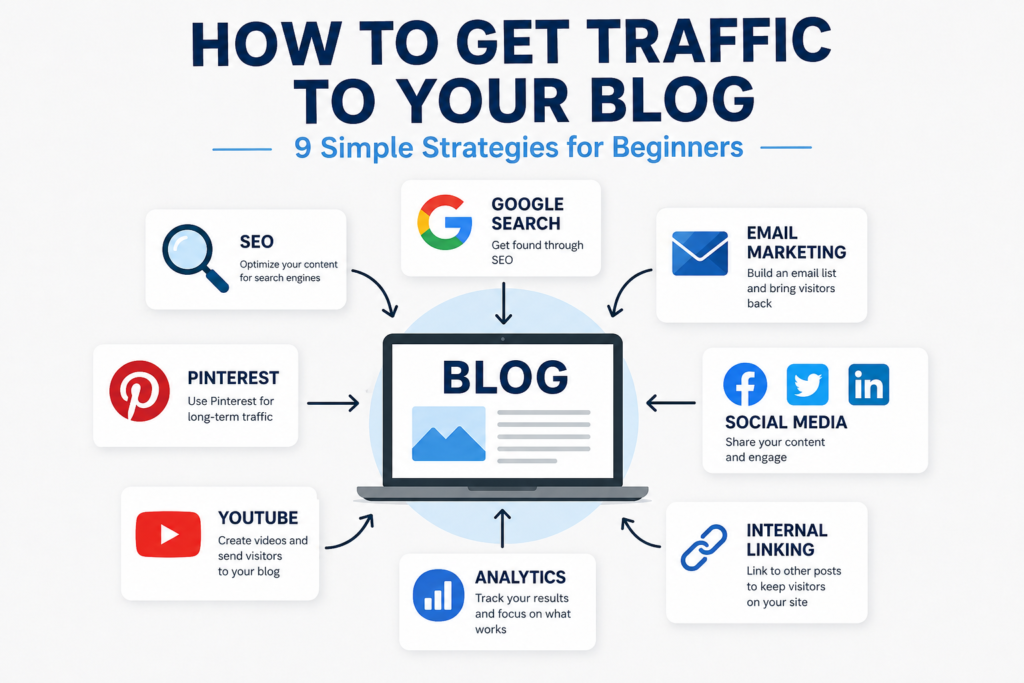
Here are nine practical strategies you can use to start increasing your blog traffic.
1. Create Content People Are Actually Searching For
One of the biggest differences between a personal blog post and a traffic-focused article is search intent.
You can certainly write about whatever interests you, and I still think personal updates have an important place on a blog.
But if your goal is organic traffic, it helps to ask:
What is somebody already typing into Google?
For example, an article called:
My Thoughts About Email Marketing
is much less specific than:
How to Build an Email List for Affiliate Marketing
The second title answers a clear question.
That makes it easier for both readers and search engines to understand what the page is about.
Before creating an article, think about the problem the reader is trying to solve.
Then build the article around solving that problem.
2. Target More Specific Keywords
Beginners often make the mistake of targeting huge keywords.
Terms such as:
- affiliate marketing
- blogging
- make money online
- email marketing
may receive plenty of searches, but they are also extremely competitive.
More specific phrases can give a smaller blog a much better opportunity.
Instead of targeting:
blog traffic
you might target:
how to get traffic to your blog
Instead of:
email marketing
you could target:
email list for affiliate marketing
These longer, more specific searches are often called long-tail keywords.
You may receive fewer searches for each individual phrase, but the visitor is usually looking for something much more specific.
That can make the traffic considerably more useful.
Want a Simple System Behind Your Traffic?
Getting visitors is only part of building an affiliate marketing business.
You also need a way to turn traffic into subscribers, follow up with those subscribers and connect them with relevant offers.
That is one of the reasons I use and recommend ClickBank Profit Club.
👉 Explore ClickBank Profit Club
It is free to join, although optional paid upgrades may be offered.
3. Improve Your On-Page SEO
You do not need to become an SEO expert before publishing your first articles.
A few basic things can already make your content easier for search engines to understand.
Your main keyword should normally appear naturally in places such as:
- the title
- the URL
- the introduction
- at least one heading
- the meta description
- image alt text
The important word here is naturally.
Repeating the same keyword twenty times does not automatically make an article better.
Your first priority should still be writing something useful for the person reading it.
I use Rank Math on my own WordPress site to help check some of these basic SEO elements before publishing.
The score can be useful as a guide, but I would rather have a natural article with a slightly lower SEO score than awkward writing created purely to satisfy a plugin.
4. Build Internal Links Between Your Articles
Internal linking is one of the simplest things you can do once your blog starts growing.
Instead of treating every article as an isolated page, connect related content together.
For example, if someone reading this article wants to learn more about building an email audience, they can read my guide:
👉 How to Build an Email List for Affiliate Marketing
That does two useful things.
First, it gives the reader somewhere relevant to go next.
Second, it helps search engines understand how the different pages on your site are related.
As your blog grows, this creates a web of useful content rather than a collection of disconnected posts.
5. Turn Every Blog Post Into Social Content
Publishing an article does not mean the work is finished.
One blog post can become several pieces of social content.
You can turn a single article into:
- a Facebook post
- a LinkedIn post
- an X post
- a Substack Note
- a Pinterest pin
- several shorter observations or tips
You do not necessarily need to copy and paste exactly the same text everywhere.
Instead, pull out one useful idea from the article and adapt it to the platform.
This gives each article several opportunities to reach people instead of relying entirely on Google.
It also means that the time spent writing a useful blog post can generate content for several other channels.
6. Use Pinterest as a Long-Term Traffic Source
Pinterest is interesting because content can potentially continue generating clicks long after it is published.
A social media post may disappear quickly from someone’s feed.
A Pinterest pin can potentially continue appearing in searches and recommendations.
For each useful blog article, you can create a vertical Pinterest image with a clear headline and link it directly back to the article.
It is another example of giving the same piece of content a second way to be discovered.
You do not need hundreds of different articles before doing this.
You can start creating pins for the useful content you already have.
7. Use YouTube to Send Visitors to Your Website
YouTube can also become part of the same system.
I have recently started experimenting with YouTube affiliate videos myself, and one thing I am increasingly interested in is how the different channels can support each other.
A YouTube video does not only have to send somebody directly to an affiliate offer.
It can also point viewers toward a useful article, review, comparison or resource on your website.
Your blog then becomes the central hub.
Someone might first discover you through YouTube, visit your website, join your email list and eventually return several times.
That is a very different relationship from getting one isolated click.
I recently wrote about some of the feedback I received while working on my second YouTube affiliate video:
👉 Online Business Progress: Mentor Feedback on My Second YouTube Video
8. Build an Email List Instead of Losing Every Visitor
Traffic is useful.
But traffic you can reach again is considerably more valuable.
Imagine that 100 people visit your blog today.
If they leave without subscribing, most of them may never return.
But if some of those visitors join your email list, you have the opportunity to continue the relationship.
You can send them:
- new articles
- useful tips
- resources
- product recommendations
- relevant affiliate offers
This is why I increasingly view traffic and list building as parts of the same system rather than separate activities.
The goal should not simply be:
How many clicks did I get today?
A better question is:
What happens after somebody clicks?
Traffic Is Only the Beginning
This is also one of the ideas behind ClickBank Profit Club: connecting traffic, list building, email follow-up and relevant affiliate offers instead of depending entirely on one-time clicks.
👉 See How ClickBank Profit Club Works
It is free to join, with optional paid upgrades available.
9. Track What Is Actually Bringing Visitors
Finally, track what happens.
It is very easy to spend time on ten different traffic strategies simply because somebody online said they work.
But your own numbers matter more.
Look at questions such as:
Which articles receive search traffic?
Which social platforms actually send visitors?
Which links get clicked?
Which pages attract subscribers?
Which content receives almost no attention?
You do not necessarily need huge amounts of data.
Even small numbers can begin showing patterns.
I have been working on improving my own tracking because I want to understand which activities are actually producing results rather than simply staying busy.
Over time, the goal is to do more of what works and less of what does not.
There Is No Single Best Traffic Source
Learning how to get traffic to your blog is probably less about discovering one magical platform and more about building several small traffic channels that support each other.
A Google search can lead to your article.
That article can lead to another article.
A visitor can join your email list.
An email can bring that person back.
A Pinterest pin can introduce somebody new to the same content.
A YouTube video can send another visitor to your website.
None of these channels has to do everything.
That is what makes the approach interesting.
Start with useful content.
Make it easy to find.
Promote it in several places.
Capture some of the traffic through your email list.
Then pay attention to what actually produces results.
That is a much more sustainable approach than constantly looking for the next traffic trick.
Want to Take Things to the Next Level?
If you already have some of the basic pieces in place and want a more structured approach to building an online business, you can also take a look at Coaching Profit System.
👉 Explore Coaching Profit System
It is a separate programme from ClickBank Profit Club and is aimed at people who want more guidance and structure as they build their online business.
Affiliate Disclosure: Some of the links on this page are affiliate links. If you purchase through one of these links, I may earn a commission at no additional cost to you.